 New Arrival
 Mobile Phones
 Tablets
 Laptop
 TV
 Accessories
 Kitchen Appliances
 Refrigerators
 Washing machines
 Air Conditioners
 Personal Care
 Home Automation
 Crockery
 Pressure Cookers
 Induction Cooktops
 Electric Kettles
 Air Fryer
 Chopper
 Wet Grinders
 Chimney
 Dish Washers
 Hand Blenders
 Ovens / Toasters /Grillers
 Gas Stoves
 Pots & Pans
 food-processor
 Dining-and-serveware
 Electric-cookers
 Fans
 Irons
 Water Heaters
 Water Purifier
 Air Coolers
 Vacuum Cleaners
 Sewing Machines
 Voltage Stabilizers
 Inverters
 Emergency Lights
 Water Dispenser
 Air Purifier
 Torch
 Mobile Accessories
 Smart Wearables
 Speakers
 Computer Accessories
 Camera Accessories
 Gaming & Accessories
 Entertainments
 Graphics Cards
 Microphone
 Car & Bike Essentials
 Power Banks
 Connectors
 Memory Cards
 Mobile Chargers & Cables
 Mobile Holders
 Smart Bands
 Sound Bars
 Home Theatres
 Portable/Trolley Speakers
 External Hard Disks
 Pendrives
 Mouse
 Keyboards
 Web Cams
 USB Hubs
 Printers
 Monitor
 Network components
 Laptop-Tables
 Tripods
 Gaming Consoles
 TV Streaming Devices
 Smart Assistants
 FM Radio
 Shavers
 Hair Dryers
 Hair Straighteners
 Perfume
 Electric Toothbrush
 Projectors
 Wi-Fi Camera
 Smart Lock
BLDC Fan Buying Guide: What to Check Before You Replace Your Old Ceiling Fan
Learn what to check before replacing your old ceiling fan, from BLDC technology and airflow to energy efficiency, room size, controls and warranty.
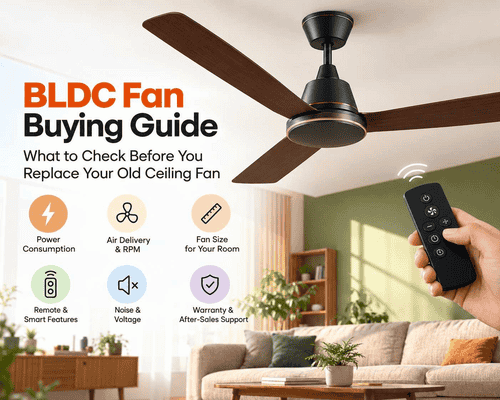
A ceiling fan is one of those appliances we use almost every day, but rarely think about replacing until it becomes noisy, slows down or starts consuming more electricity than expected. If you're planning to upgrade, a BLDC ceiling fan is worth considering.
Unlike conventional fans that use induction motors, BLDC fans use brushless direct-current motor technology designed to deliver airflow with lower power consumption. Depending on the model, they may also offer remote control, timer settings, sleep modes and other convenient features.
But choosing the right fan involves more than picking a model that looks modern or promises electricity savings. Airflow, room size, power consumption, installation requirements and warranty all matter.
If you're exploring a BLDC fan in India, this guide will help you understand what to check before replacing your existing ceiling fan and how to choose one that suits your home.
What Makes a BLDC Fan Different from a Regular Ceiling Fan?
The main difference is the motor technology.
A conventional ceiling fan typically uses an induction motor, while a BLDC fan uses a brushless direct-current motor with electronic control. This design can reduce electricity consumption while providing useful features such as remote-based speed adjustment.
Many conventional ceiling fans consume around 60–80 watts, while BLDC models commonly operate in the range of 25–35 watts, depending on the model and speed setting. This difference can make a BLDC fan particularly attractive for rooms where the fan runs for several hours every day.
Here is a quick comparison:
| Feature | Regular Ceiling Fan | BLDC Ceiling Fan |
| Motor technology | Conventional induction motor | Brushless DC motor |
| Electricity consumption | Generally higher | Generally lower |
| Speed control | Often wall regulator | Remote, regulator or smart controls, depending on the model |
| Additional features | Varies by model | May include timers, sleep modes and smart controls |
| Initial cost | Often lower | Can be higher |
| Long-term running cost | Depends on usage and power rating | Can be lower due to reduced power consumption |
The important point is that a BLDC fan is not automatically the best choice for every situation. The value depends on how often you use the fan, its actual power rating and the features you need.
When Should You Replace Your Old Ceiling Fan?
Before buying a new fan, consider whether your existing one is still performing as it should.
The Fan Has Become Noisy
Unusual humming, rattling or vibration can indicate loose fittings, worn components or a motor problem. Some issues can be resolved through maintenance, so replacing the entire fan may not always be necessary.
However, if the fan is old and continues to perform poorly after servicing, upgrading may be worth considering.
Airflow Is No Longer Satisfactory
If the fan runs but doesn't provide comfortable airflow, the problem could involve dust accumulation, worn components, unsuitable speed settings or the fan's design.
Clean the blades and check the fan's condition first. If airflow remains inadequate, compare replacement models based on their air delivery rather than choosing solely by RPM.
You Want to Reduce Electricity Consumption
A fan that runs for many hours a day contributes to household electricity use. Replacing a high-consumption model with an efficient BLDC fan can reduce the energy required to operate it.
The potential savings depend on the power ratings of both fans, daily usage, electricity tariff and the speed at which you operate them.
You Want More Convenient Controls
If you regularly adjust the fan speed or prefer to switch it off without getting out of bed, a remote-controlled model may be useful.
Some BLDC fans also offer timer settings and sleep modes. If your existing fan works well but lacks these features, an upgrade can improve convenience as well as energy efficiency.
7 Things to Check Before Buying a BLDC Fan
Once you've decided to upgrade, these are the specifications and practical details worth checking before placing your order.
1. Match the Fan Size to Your Room
Fan size is one of the first things to check when replacing an old ceiling fan.
The blade sweep, measured in millimetres, affects the area the fan can serve. A 1200 mm fan is a common choice for bedrooms and living rooms, while smaller sizes may suit compact rooms or spaces with installation restrictions.
Use your room dimensions as a starting point:
| Room type | What to consider |
| Small bedroom or study room | A smaller sweep may be sufficient, depending on the layout |
| Standard bedroom | A 1200 mm fan is a common option |
| Large living room or hall | Consider the room area, airflow requirements and whether more than one fan is needed |
These are general guidelines rather than fixed rules. Ceiling height, room layout, furniture placement and the manufacturer's recommendations should also influence your choice.
Before buying: Check the size of your existing fan and confirm that the replacement is suitable for the room and mounting arrangement.
2. Check Air Delivery, Not Just RPM
RPM stands for revolutions per minute and indicates how quickly the blades rotate. However, a higher RPM does not automatically mean that a fan will provide better airflow throughout your room.
Air delivery, commonly measured in CMM (cubic metres per minute), indicates the volume of air moved by the fan.
When comparing two BLDC models, look at both RPM and air delivery. Blade design and pitch also affect performance, so avoid choosing a fan based on motor speed alone.
If your old fan struggles to circulate air effectively, prioritise a replacement with suitable air delivery for your room.
3. Compare Power Consumption and BEE Star Ratings
One of the main reasons to switch to a BLDC fan is its potential to reduce electricity consumption.
Check the wattage listed on the product specification sheet. A lower wattage generally means less electricity is used at the rated operating condition, but it should be considered alongside airflow. A fan that consumes less power but does not provide adequate airflow may not meet your needs.
You should also check the BEE star rating where applicable. The Bureau of Energy Efficiency's Standards and Labelling programme helps consumers compare appliances based on energy performance.
A higher star rating can help you identify a more efficient model within the relevant rating scheme. Always compare the rating, wattage and air delivery together rather than relying on a single specification.
4. Understand the Remote and Regulator Requirements
Many BLDC ceiling fans come with a remote control for adjusting speed and accessing additional functions.
Depending on the model, the fan may use a remote, a compatible wall control or both. Some models may require a different control arrangement from the one used by your existing fan.
Before buying, check:
- • Whether a remote is included in the package
- • Whether the fan supports your preferred wall-control arrangement
- • Whether the existing regulator can remain in use
- • Whether timer, sleep or boost modes are available
- • Whether replacement remotes can be obtained if needed
Important: Do not assume your existing wall regulator will work with every BLDC fan. Follow the manufacturer's installation instructions and consult a qualified electrician if the wiring or control arrangement needs to change.
5. Consider Noise and Voltage Requirements
A fan should provide comfortable airflow without becoming distracting, particularly in bedrooms and study rooms.
If low noise is important to you, check the manufacturer's noise specifications where available. Installation quality, loose fittings and the condition of the ceiling mount can also affect noise and vibration.
Voltage requirements are another detail worth checking. If your area experiences voltage fluctuations, look for a model whose specified operating range suits your electrical supply. Do not assume every BLDC fan supports the same voltage range.
These details may not be as noticeable as the fan's appearance, but they can make a difference to everyday use.
6. Check Warranty and After-Sales Support
A ceiling fan is a long-term household purchase, so warranty coverage matters.
Before choosing a model, check:
- • Warranty coverage for the motor and other components
- • Whether the remote and electronic controls are covered
- • The availability of service support
- • The process for obtaining replacement parts
- • Any installation or warranty conditions
Warranty periods and terms vary by brand and model. Read the product details carefully rather than assuming that every BLDC fan offers the same coverage.
7. Check Installation and Existing Mounting
Replacing a ceiling fan may appear straightforward, but the new model still needs to be compatible with the existing mounting arrangement and electrical connection.
Check the downrod, canopy, mounting hardware and ceiling clearance requirements. If the new fan has a different design or control system, additional installation work may be necessary.
For safety, have the fan installed by a qualified electrician, especially if wiring, mounting hardware or the control arrangement needs to be changed.
Also Read: High Speed Ceiling Fan: Is It Actually Cooling You More or Just Running Up Your Electricity Bill?
BLDC Fan Price in India: What Affects the Cost?
The BLDC fan price in India varies depending on the brand, motor technology, blade size, energy rating, design and included features.
A basic model may focus on efficient operation and straightforward remote control, while more advanced models can include smart connectivity, decorative finishes, integrated lighting or additional operating modes.
Before choosing a fan, consider what you will actually use. If your main priority is reducing electricity consumption, compare wattage, air delivery and energy ratings. If convenience matters more, you may prefer a model with a remote, timer or smart controls.
You can also explore the ceiling fans available at myG to compare BLDC models, specifications and available designs. Product prices and stock can change, so check the current listing before making your purchase.
The best BLDC fan is not necessarily the most expensive one. It is the model that balances suitable airflow, efficient operation, useful features and reliable support for your home.
How Much Can You Save by Replacing an Old Fan?
The savings depend on the difference between the old fan's power consumption and the new BLDC model's consumption, along with how many hours the fan runs.
For example, consider replacing a 75W fan with a 30W BLDC fan.
- • Power reduction: 45 watts
- • Daily usage: 10 hours
- • Electricity tariff: ₹7 per unit
The estimated saving for one fan would be:
| Calculation | Result |
| Difference in power consumption | 45W |
| Electricity saved per day | 0.45 kWh |
| Electricity saved per year | Approximately 164 units |
| Estimated annual saving | Approximately ₹1,150 |
This is an illustrative calculation, not a guaranteed saving. Actual results depend on the fan's real power consumption, operating speed, usage hours and electricity tariff.
If you have several fans running daily, the combined reduction in electricity use may be more noticeable. However, compare the upfront cost of the new fan with the expected savings before deciding when to replace a working model.
Is a BLDC Fan Worth It for Your Home?
A BLDC fan is worth considering if your current fan consumes more electricity, runs for many hours a day or needs frequent speed adjustments.
It may be particularly suitable for bedrooms, living rooms and other spaces where the fan is used regularly. The lower power consumption can add up over time, while remote controls and timer functions can make daily use more convenient.
However, if your current fan provides good airflow, consumes relatively little electricity and meets your needs, immediate replacement may not be necessary. You can compare the expected savings and features before making a decision.
The goal is not simply to replace an old fan with a newer one. It is to choose a fan that delivers comfortable airflow, suits your room and offers value over its useful life.
Find the Right BLDC Fan at myG
Replacing your old ceiling fan is an opportunity to improve energy efficiency, airflow and everyday convenience.
At myG, you can explore BLDC ceiling fans from brands including Atomberg, Havells, Crompton, Bajaj and V-Guard, with different sizes, designs and features available across the range.
Before choosing, compare the wattage, air delivery, star rating, control options, warranty and installation requirements. A little research can help you select a fan that meets your needs today while making everyday comfort more efficient.
Ready to upgrade your ceiling fan? Explore BLDC fans at myG and find the right fit for your home.
 Earphones