 New Arrival
 Mobile Phones
 Tablets
 Laptop
 TV
TV Accessories
 Kitchen Appliances
 Refrigerators
 Washing machines
 Air Conditioners
 Personal Care
 Home Automation
 Crockery
 Pressure Cookers
 Induction Cooktops
 Electric Kettles
  Air Fryer
 Chopper
 Wet Grinders
 Chimney
 Dish Washers
 Hand Blenders
 Ovens / Toasters /Grillers
 Gas Stoves
 Pots & Pans
 food-processor
 Dining-and-serveware
 Electric-cookers
 Fans
Fans Irons
Irons Water Heaters
 Water Purifier
 Air Coolers
 Vacuum Cleaners
 Sewing Machines
 Voltage Stabilizers
 Inverters
 Emergency Lights
 Water Dispenser
 Air Purifier
 Torch
Torch Mobile Accessories
 Smart Wearables
 Speakers
 Computer Accessories
 Camera Accessories
 Gaming & Accessories
 Entertainments
 Graphics Cards
 Microphone
 Car & Bike Essentials
 Power Banks
 Connectors
 Memory Cards
 Mobile Chargers & Cables
 Mobile Holders
 Smart Bands
 Sound Bars
 Home Theatres
 Portable/Trolley Speakers
 External Hard Disks
 Pendrives
 Mouse
Mouse Keyboards
 Web Cams
 USB Hubs
 Printers
 Monitor
 Network components
 Laptop-Tables
 Tripods
 Gaming Consoles
 TV Streaming Devices
 Smart Assistants
 FM Radio
 Shavers
 Hair Dryers
 Hair Straighteners
 Perfume
 Electric Toothbrush
 Projectors
 Smart Security Accessories
 Wi-Fi Camera
Tired of Damp, Wrinkled Clothes This Monsoon? The Right Iron Box Can Fix That
Struggling with damp, wrinkled clothes during monsoon? Learn how to choose the best iron boxes in India, compare steam iron box features, and find reliable options at the iron box lowest price for faster, easier ironing.
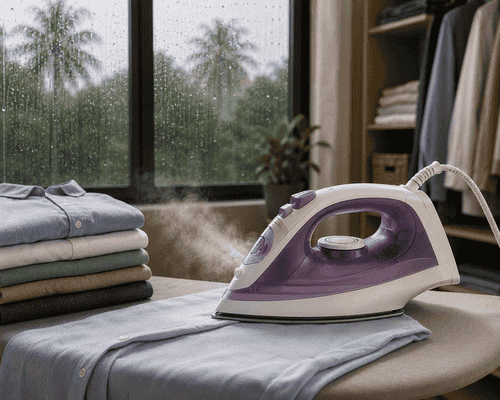
Monsoon season brings cooler weather, but it also leaves clothes damp, wrinkled, and difficult to iron. In Kerala, months of high humidity prevent clothes from drying completely, causing deep creases that are harder to remove than usual.
If you find that ironing takes longer during the rainy season or that your clothes become wrinkled again soon after ironing, your current iron may not be suited for monsoon conditions. This is why many households look for the best iron boxes during this time. A good steam iron box can penetrate fabric more effectively, remove stubborn wrinkles faster, and help clothes stay crisp for longer.
This guide tells you exactly what to look for in a steam iron box for monsoon use and which features actually matter in Kerala's conditions.
By the end you will know which type of iron box handles monsoon fabric, which soleplate suits which clothes, why steam output in g/min is the most important number to check.
Why Monsoon Makes Ironing Harder — The Science in Simple Terms
Before picking an iron box, understand what you are actually dealing with.
During Kerala's monsoon — June to October, relative humidity stays between 80 and 95 percent. When you wash clothes and hang them to dry indoors or in a covered area, evaporation slows dramatically. The fabric dries to a point but retains a percentage of moisture in the fibres.
When that slightly damp fabric is folded or hung for a few hours, the fibres cool and set in whatever position they are in with moisture holding the wrinkles tighter than any dry-season crease. This is why monsoon ironing takes twice as long and leaves results that do not last.
A dry iron box applies heat to the surface. For deep monsoon wrinkles held by moisture inside the fabric, surface heat alone is not enough. The fibres need steam, warm moisture that penetrates into the fabric, temporarily relaxes the polymer chains, and lets the soleplate press them into a flat position.
A steam iron box pushes steam into the fabric first, loosens the moisture-set wrinkles, and then the hot soleplate sets them flat. The difference in results, especially on cotton sarees, linen shirts, and school uniforms is visible from the first stroke.
The 5 Features That Matter Most During Monsoon
1. Steam Output — The Number Every Buyer Ignores
Steam output is measured in grams per minute (g/min). This single number determines how effectively an iron box deals with monsoon fabric. Most buyers look at wattage. The number that actually matters is g/min.
- • Below 10 g/min: Light steam, adequate for dry-season cotton. Struggles with monsoon-set wrinkles in heavier fabric.
- • 10 to 15 g/min: The sweet spot for most Indian homes. Handles cotton sarees, linen shirts, uniforms, and light synthetic fabric effectively.
- • Above 15 g/min: Premium output. Works on thick denim, heavy cotton curtains, and fabric that has been damp for hours.
The Havells Nimo Steam Iron delivers 12 g/min — the minimum recommended for monsoon use. The Philips GC1905 delivers 13 g/min continuously.
2. Soleplate Material — The Contact Point That Decides Results
The soleplate is the hot surface that touches your clothes. Three materials are available at different price points:
- Non-stick soleplate: The most common in mid-range irons. Smooth gliding, good for synthetic and delicate fabric. Does not stick to polyester. The Orient Electric FabriFeel uses a Weilburger-coated non-stick soleplate specifically designed for mixed fabric households.
- Ceramic soleplate: Better heat distribution than non-stick. Gentler on fabric. Glides more smoothly. The Black and Decker BXIR2001IN uses a ceramic soleplate and is the recommended choice for households with expensive cotton sarees, silk blends, or formal shirts that need careful handling.
- Aluminium soleplate: Found in entry-level and budget irons. Heats fast, cools fast. Less smooth than ceramic or non-stick but perfectly adequate for basic cotton and synthetic use. The Philips GC1905 uses an American Heritage Black aluminium soleplate that glides well on standard fabrics.
- For monsoon use: Ceramic and non-stick soleplates are preferred, they handle the wider range of fabric you will iron and reduce the risk of damage to damp or slightly sticky fabric.
3. Anti-Drip Function — Essential in Kerala's Hard Water Conditions
When a steam iron's soleplate temperature drops below the water's boiling point, water drips out of the steam vents instead of converting to steam. This leaves water marks on fabric particularly damaging on silk, synthetic, and dark-coloured clothing.
Kerala's tap water has varying levels of mineral content. In areas with hard water, mineral deposits build up in the steam vents faster, increasing the risk of dripping and discolouring clothes.
Anti-drip function detects when the iron is not hot enough to produce clean steam and automatically stops water release at that point. The Black and Decker BXIR2001IN includes anti-drip as a standard feature — a meaningful protection for Kerala households.
4. Self-Clean Function — Fighting Kerala's Hard Water Deposits
Hard water produces limestone and calcium deposits inside the steam channels and vents of a steam iron. Over months of use, these deposits restrict steam output, reduce iron performance, and can eventually block the vents entirely.
The self-clean function flushes the steam channels with a burst of steam and boiling water, pushing out mineral deposits. The Havells Nimo Steam Iron includes self-clean as a standard feature, which directly extends the useful life of the iron in Kerala's conditions.
5. Wattage — Getting the Balance Right
Higher wattage means faster heating and more powerful steam. But it also means higher electricity consumption and potentially more heat than delicate fabrics can handle.
- • 1000W to 1200W: Adequate for light use — occasional ironing, small households, delicate fabric users. Orient Electric FabriFeel at 1200W fits here.
- • 1440W to 1600W: The home-use sweet spot. Fast enough for a full week's ironing session. Havells Nimo (1200W) and Philips GC1905 (1440W) cover this range.
- • 1800W to 2000W: For large households with heavy fabric — denim, thick cotton curtains, multiple school uniforms daily. Black and Decker BXIR2001IN at 2000W and Bajaj MX35N at 2000W.
Fabric-Wise Guide: Which Setting for Which Monsoon Clothes
This is the section that saves fabric during monsoon when you are rushing through a pile of damp-dried clothes.
| Fabric | Temperature | Steam | Tip |
| Silk and satin | Low (Nylon/Silk mark) | No steam or very light | Iron inside out. Never press directly on sequins or embroidery. |
| Synthetic and polyester | Low to medium | Light steam | High heat melts synthetic fibres. Use a pressing cloth if unsure. |
| Cotton — shirts and uniforms | Medium to high | Full steam | Iron while slightly damp for best results. Works even better with steam. |
| Cotton sarees | Medium to high | Full steam | Use steam burst on pleats and borders. Iron the pallu last. |
| Linen | High | Full steam | Most difficult to iron dry. Steam is essential. Iron while damp. |
| Denim and thick cotton | Highest | Maximum steam | Multiple slow passes with full steam. Press firmly. |
| Woollen fabric | Medium | Steam with pressing cloth | Never iron directly on wool. Always use a damp pressing cloth in between. |
Top Iron Box Picks: Features & Specifications
| Best Model at myG | What You Get |
| Basic dry iron, 1000 to 1200W, standard soleplate | |
| Entry steam iron, non-stick soleplate, 1200W, basic steam | |
| Mid-range steam iron, 1440W, 13 g/min, spray and burst | |
| Premium steam iron, ceramic soleplate, 2000W, anti-drip, auto shut-off |
Monsoon Ironing Tips That Make Any Iron Box Work Better
The iron box matters. So does technique. These five tips apply specifically to monsoon conditions in Kerala and South India.
- • Iron clothes while they are still slightly damp: If clothes have been hanging in humid monsoon air, they are already carrying some moisture. Iron them before they fully cool — the residual warmth and slight dampness reduce the effort needed to flatten wrinkles significantly.
- • Increase temperature by one notch in monsoon: Humidity in the air cools the soleplate slightly faster. Setting the temperature one position higher than you would in summer compensates for this.
- • Use the steam burst button for stubborn monsoon creases: Regular continuous steam may not be enough for moisture-set creases in thick cotton or linen. A concentrated steam burst directly on the crease before pressing relaxes the fibres quickly.
- • Hang ironed clothes immediately: In high humidity, freshly ironed clothes re-crease faster if folded or piled immediately. Hang them on a hanger for at least 10 minutes before folding.
- • Drain the water tank after every use: In Kerala's monsoon humidity, leaving water in the tank encourages algae growth and accelerates mineral deposit buildup in the steam vents. Takes 30 seconds. Extends the iron's life by years.
Frequently Asked Questions
Which is the best iron box for monsoon use in Kerala?
A steam iron with at least 12 g/min steam output and an anti-drip function is the right choice for Kerala's monsoon. The Philips GC1905 at 13 g/min is the best-value option. For larger households with heavier fabric, the Black and Decker BXIR2001IN is the premium recommendation.
Is a steam iron box better than a dry iron for Indian monsoon?
Yes, significantly. Dry heat alone cannot penetrate the moisture-set wrinkles that develop when clothes dry slowly in 85 to 95% humidity. Steam loosens the moisture-locked fibres first, making them easy to press flat. On cotton sarees, linen shirts, and school uniforms in monsoon, the difference is immediate and visible.
What does anti-drip do and why does it matter?
Anti-drip prevents water from leaking out of the steam vents when the iron is not hot enough to convert it to clean steam. Without this feature, water drops on fabric cause stains — especially on silk, dark cotton, and synthetic material. In Kerala's mineral-heavy water, anti-drip combined with a self-clean function is the most important maintenance feature to look for.
How much steam output do I need for ironing sarees?
For cotton sarees, 12 g/min is the minimum recommended. For silk or chiffon sarees, avoid direct steam — use a pressing cloth and iron on a lower temperature without steam. For thick cotton or raw silk sarees with heavy borders, 13 g/min with steam burst is ideal.
How often should I descale my steam iron in Kerala?
In areas with hard water, which includes most of Kerala — descale every 4 to 6 weeks during monsoon when the iron is used more frequently. Use the self-clean function after every 10 to 15 ironing sessions. Fill the tank with plain water, activate self-clean, and let the steam flush out mineral deposits. This keeps steam output at full capacity and prevents water marks on clothes.
Conclusion: The Right Iron Box Makes Monsoon Mornings Faster
The monsoon will make your clothes damp and wrinkled no matter what. The right steam iron box makes sure that problem takes five minutes to fix — not twenty.
For most Kerala households in monsoon: a steam iron with 12 to 13 g/min output, a non-stick or ceramic soleplate, and a self-clean function is all you need. The Havells Nimo or the Philips GC1905 handle 90% of everyday monsoon ironing perfectly. If your household irons heavy fabric daily, the Black and Decker BXIR2001IN is the right upgrade.
All of these are available at myG — with genuine warranty, transparent pricing, and the option to buy online at myg.in or walk into your nearest myG store.
Your monsoon wardrobe is waiting. The right iron box is at myG.
 Earphones