
 New Arrival
 Mobile Phones
 Tablets
 Laptop
 TV
TV Accessories
 Kitchen Appliances
 Refrigerators
 Washing machines
 Air Conditioners
 Personal Care
 Home Automation
 Crockery
 Pressure Cookers
 Induction Cooktops
 Electric Kettles
  Air Fryer
 Chopper
 Wet Grinders
 Chimney
 Dish Washers
 Hand Blenders
 Ovens / Toasters /Grillers
 Gas Stoves
 Pots & Pans
 food-processor
 Dining-and-serveware
 Electric-cookers
 Fans
Fans Irons
Irons Water Heaters
 Water Purifier
 Air Coolers
 Vacuum Cleaners
 Sewing Machines
 Voltage Stabilizers
 Inverters
 Emergency Lights
 Water Dispenser
 Air Purifier
 Torch
Torch Mobile Accessories
 Smart Wearables
 Speakers
 Computer Accessories
 Camera Accessories
 Gaming & Accessories
 Entertainments
 Graphics Cards
 Microphone
 Car & Bike Essentials
 Power Banks
 Connectors
 Memory Cards
 Mobile Chargers & Cables
 Mobile Holders
 Smart Bands
 Sound Bars
 Home Theatres
 Portable/Trolley Speakers
 External Hard Disks
 Pendrives
 Mouse
Mouse Keyboards
 Web Cams
 USB Hubs
 Printers
 Monitor
 Network components
 Laptop-Tables
 Tripods
 Gaming Consoles
 TV Streaming Devices
 Smart Assistants
 FM Radio
 Shavers
 Hair Dryers
 Hair Straighteners
 Perfume
 Electric Toothbrush
 Projectors
 Smart Security Accessories
 Wi-Fi Camera
How to Choose the Right Garment Steamer: Everything You Need to Know Before You Buy
Looking for the right garment steamer? This guide explains the difference between handheld and upright steamers, key features to consider, fabric compatibility, and the best garment steamers available at myG to help you choose the perfect model for your home.
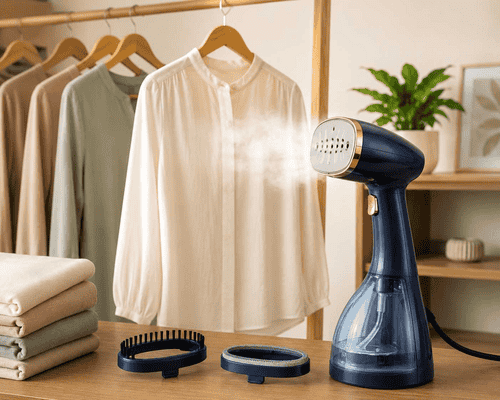
A garment steamer does in 60 seconds what an iron box takes 5 minutes to do and it does it without a board, without pressing, and without any risk of burning your clothes.
If you have ever spent 20 minutes ironing a silk saree only to find a shiny patch from pressing too hard, or if you have noticed that your favourite cotton kurta comes out looking stiffer after ironing — a garment steamer is what you have been missing.
Garment steamers work differently from iron boxes. They do not press fabric. They relax it. Hot steam penetrates the fibres, releases the tension that creates wrinkles, and lets them fall naturally smooth. No pressure. No contact damage. No need for an ironing board. You hang the garment, run the steamer across it, and in under a minute it looks freshly laundered.
But choosing the right garment steamer — handheld vs upright, tank size, steam output, with or without a garment pole is where most buyers get confused. This guide clears that up completely.
Garment Steamer vs Iron Box: Which One Is Right for You?
Before choosing a steamer, understand the key difference in how they work — because that determines which one your home actually needs.
|
| Garment Steamer | Iron Box |
| How it works | Steam relaxes wrinkles without contact | Heat and pressure flatten wrinkles |
| Best for | Delicate fabrics, hung garments, quick refresh | Sharp creases, formal shirts, cotton uniforms |
| Risk to fabric | Very low — no direct contact | Moderate — shine marks, scorch risk on synthetics |
| Setup needed | None — just hang the garment | Ironing board required |
| Speed | 30 to 60 seconds per garment | 3 to 5 minutes per garment |
| Creases on formal shirts | Good for light creases, not sharp | Sharp, crisp results |
| Sarees, silk, chiffon | Excellent — no damage risk | Requires pressing cloth and care |
| Kills bacteria and odours | Yes — steam sanitises fabric | No — heat only |
A garment steamer is not a replacement for an iron box. It is a different tool for a different job. If you wear silk sarees, delicate ethnic wear, or frequently need to refresh hanging clothes quickly — a steamer is the right primary tool. If you need sharp collar creases and pressed trouser lines — keep your iron box and add a steamer for everything else.
Many Kerala households benefit from owning both. An iron box for school uniforms and formal shirts. A handheld garment steamer for sarees, kurtas, and party wear.
The Two Types of Garment Steamers — Which One Fits Your Home
Handheld Garment Steamer
A compact, handheld device that you point at a hanging garment. Typically 900W to 1500W, with a water tank of 100ml to 200ml. Heats up in 20 to 30 seconds. Works standing up — no board, no surface required.
Best for:
- • Single people, couples, or small families
- • Apartments and homes with limited storage
- • Quick wrinkle removal between wears
- • Travel use or occasional freshening up of hanging clothes
- • Sarees, silk, chiffon, georgette, linen, and lightweight ethnic wear
Limitation: Smaller water tank means more frequent refills during long sessions. Not ideal for pressing large quantities of thick cotton daily.
Standing Upright Garment Steamer
A floor-standing unit with a large water tank (1 litre and above), an adjustable pole with a garment hanger, and a steam hose with a nozzle. Produces high-volume continuous steam for extended sessions.
Best for:
- • Larger families with daily steaming needs
- • Households with heavy saree collections, curtains, and large fabric items
- • Boutiques, tailors, and home businesses needing professional results
- • Users who want to steam multiple garments in one session without refilling
Limitation: Larger footprint, takes longer to heat up (1 to 2 minutes), and needs storage space.
The 5 Features That Actually Matter When Choosing a Garment Steamer
1. Steam Output — Grams Per Minute (g/min)
This is the single most important specification. Steam output determines how effectively and quickly the steamer removes wrinkles from different fabric weights.
- • 15 to 20 g/min: Handles light fabrics — silk, chiffon, georgette, synthetic. Good for quick refresh sessions.
- • 20 to 28 g/min: The all-round range. Works on cotton sarees, linen kurtas, light jackets. Handles most Indian household fabric types.
- • 28 to 35 g/min: Premium output for thick cotton, denim, heavy curtains, and stubborn wrinkles that have set over days.
The Usha Techne Direct 500 delivers 20 g/min with a steam burst option — the right range for mixed Indian household fabric. The Philips GC487/80 delivers 35 g/min — designed for high-volume professional use.
2. Heat-Up Time — The Daily Use Factor
This is about convenience, not performance. A steamer that takes 2 minutes to heat up will often go unused for quick morning touch-ups. A steamer that is ready in 25 seconds gets used every day.
- • Under 30 seconds: Ideal for daily use. Xiaomi MJGTJ02LF heats up in under 26 seconds.
- • 30 to 60 seconds: Standard for most handheld models. Tefal Access Steam Pocket reaches temperature quickly with its compact design.
- • 1 to 2 minutes: Typical for upright standing steamers — acceptable for planned sessions, not for quick fixes.
3. Water Tank Capacity — How Long You Can Steam Without Refilling
Smaller tanks heat up faster and are lighter to hold. Larger tanks let you steam continuously without interruption.
- • 100 to 160ml: 5 to 8 minutes of continuous steam. Good for 2 to 3 garments per fill.
- • 200 to 300ml: 10 to 15 minutes of continuous steam. Covers a full session for a small household.
- • 1 litre and above: 30 to 45 minutes continuous. For upright standing steamers designed for large daily loads.
The Tefal Access Steam Pocket is built for portability — compact tank, lightweight, designed for quick sessions. The Philips Upright STE 1030/20 carries a large tank for extended continuous use.
4. Fabric Compatibility and Attachments
Most garment steamers come with one or more attachments that extend what you can steam:
- • Fabric brush: Raises fabric pile on velvet, wool, and upholstery for a refreshed finish.
- • Creasing tool: Creates a crisp crease on trousers and sleeves — giving you some of the sharpness of an iron without the pressure.
- • Lint brush: Removes surface lint and hair while steaming.
For Indian households with diverse fabric, cotton sarees, chiffon dupatta, silk blouses, polyester kurtas, a steamer that can handle all of these without attachments is the priority. Look for models that specifically state compatibility with delicate and embellished fabric.
5. Vertical and Horizontal Steam Capability
Standard steamers work vertically, you steam garments hanging on a hanger or pole. Some models also support horizontal steaming, which lets you steam a garment lying flat — useful for sarees, curtains, and bedsheets.
The Usha Techne Direct 500 specifically mentions no ironing board needed and horizontal steaming capability, a practical feature for Kerala households where large sarees and bed linen are common items to care for.
Which Fabrics Work Best with a Garment Steamer
This is the most important practical section — because the steamer excels on fabrics the iron box struggles with.
Silk sarees and blouses: Steam is the safest method. No contact with the soleplate means no shine marks, no scorch risk, and no damage to zari or embroidery. Hold the nozzle 1 to 2 cm from the fabric. Work top to bottom. Steam removes every storage crease in under 2 minutes.
Chiffon and georgette dupattas: These wrinkle easily and damage easily. Steam is the only reliable method for refreshing them between wears. An iron box at any setting risks stretching or marking chiffon permanently.
Embellished and embroidered fabric: Anarkalis, lehengas, and party wear kurtas with heavy embellishment cannot be safely ironed. Steam from the reverse side of the fabric — point the nozzle at the back of the garment to release wrinkles without any contact with the embellishment.
Linen and cotton kurtas: Steam is excellent for linen. Hold the nozzle close and apply firm steam — linen releases its wrinkles quickly with hot steam. For cotton kurtas, steam works well for a fresh look but will not give you the sharp pressed lines of an iron.
Curtains and upholstery: A standing upright steamer handles household curtains, sofa fabric, and mattress tops — refreshing and deodorising them without taking them down. This is a use case the iron box cannot match at all.
Fabric that does not respond well to steam: Very thick denim, starched cotton school uniforms, and formal dress shirts where a sharp crease is needed. For these, an iron box remains the better tool.
Best Garment Steamers Available at myG
Tefal Access Steam Pocket Garment Steamer
The most compact and lightweight garment steamer at myG. The Access Steam Pocket is Tefal's portable handheld model, designed for quick sessions and easy storage. Ready to use in seconds, lightweight enough to hold comfortably through a full saree or a set of hanging kurtas. Rose Gold, Black, and White colour options available. The right entry point for anyone trying a garment steamer for the first time.
Best for: Small households, occasional use, delicate fabric refresh, travel-friendly garment care.
Philips Handheld Steamer 5000 Series STH5010/70
The Philips 5000 Series handheld steamer brings Philips' trusted quality. Compact, powerful, and designed for everyday home use. The 5000 Series delivers better steam output and more durable construction than entry-level models, Philips' mid-range represents the best balance of price and performance in their steamer lineup.
Best for: Daily use households, mixed fabric types, buyers who want a reliable branded product with Philips' service network.
Usha Techne Direct 500 Garment Steamer
Usha Techne Direct 500 Garment Steamer - 1300W power. Quick steam function ready in 25 seconds. Steam output up to 20 g/min. Two settings — Light and Heavy for different fabric types. No ironing board needed. Suits all fabric types from embellished sarees to delicate silk. Horizontal and vertical steaming capability.
Best for: Households with mixed fabric including heavy sarees, ethnic wear, and everyday cotton garments. The two-steam-setting design makes it versatile across fabrics.
Philips Upright Garment Steamer STE 1030/20
Philips Upright Garment Steamer - The premium standing upright option at myG. Large water tank for extended sessions. Adjustable pole with garment hanger built in, hang the garment and steam hands-free without holding the clothing yourself. Three steam settings for different fabrics. Ideal for large households, boutiques, or anyone who steams multiple garments daily and needs professional results consistently.
Best for: Large families, heavy daily use, curtains and large household fabric, boutique and home business use.
How to Use a Garment Steamer — 5 Tips for Best Results
Getting the most from your garment steamer is mostly about technique. These five tips make an immediate difference.
Hang the garment before you start. A steamer works with gravity, steam rises through hanging fabric and wrinkles fall naturally. Steaming fabric lying flat reduces effectiveness significantly except for the horizontal steaming mode on compatible models.
Fill with filtered or distilled water. Tap water in most Kerala districts carries minerals. Mineral buildup in the steam nozzle reduces output over time and eventually causes dripping. Filtered water extends your steamer's lifespan. Descale every 4 to 6 weeks using the steamer's descaling function.
Keep the nozzle 1 to 2 cm from the fabric. Too close and you risk water droplets on the fabric. Too far and the steam dissipates before reaching the fibres. The right distance is close enough to feel the steam on your hand but not touching the fabric.
Work top to bottom in overlapping strokes. Start at the collar or shoulder and move downward. Overlap each stroke slightly. For sarees, steam the body first then focus on pleats and the pallu.
Let fabric cool before wearing or folding. Steamed fabric is temporarily elastic. Give it 2 to 3 minutes to cool and set. Folding immediately can reset the wrinkles you just removed.
Frequently Asked Questions
What is the best garment steamer for home use in India?
For most Indian homes, the Philips 5000 Series Handheld Steamer STH5010/70 is the best balance of performance, brand reliability, and price. For larger households or boutique use, the Philips Upright STE 1030/20 is the premium choice. Both are available at myG.
Is a garment steamer better than an iron box?
Neither is universally better. A garment steamer is better for delicate fabric — silk, chiffon, embellished ethnic wear, curtains, and anything that cannot be ironed safely. An iron box is better for sharp creases on formal shirts, cotton school uniforms, and pressed trouser lines. The best-equipped household has both.
Can a garment steamer damage clothes?
When used correctly, a garment steamer is significantly safer than an iron box on most fabric types because there is no direct contact or pressure. The only risk is holding the nozzle too close, which can cause water droplets. On velvet, always steam in the direction of the pile. On heavily beaded fabric, steam from the reverse side only.
How long does it take for a garment steamer to heat up?
Compact handheld models heat up in 20 to 30 seconds. The Usha Techne Direct 500 is ready in 25 seconds. Standing upright models take 1 to 2 minutes. For daily morning use, a compact model with under-30-second heat-up time is the practical choice.
Can I use a garment steamer on sarees?
Yes — a garment steamer is one of the safest and most effective ways to care for sarees, particularly silk, chiffon, and georgette varieties. Hang the saree on a hanger or pole, work from top to bottom with the nozzle 1 to 2 cm from the fabric, and use a steam burst on heavy pleats and borders. Results are visible in under 2 minutes.
Conclusion: Choose the Steamer That Fits the Way You Live
A garment steamer is not a gadget. For the right household, it is the most-used appliance in the wardrobe room — faster, safer, and more versatile than an iron box for a wide range of fabric.
The right choice comes down to two questions: how often do you steam, and what do you primarily steam?
For occasional use and delicate fabric, the Tefal Access Steam Pocket is the right start. For daily home use with mixed fabric, the Philips STH5010/70 is the reliable mid-range choice. For large families or anyone steaming curtains and sarees in volume, the Philips Upright STE 1030/20 at Rs. 7,790 is built for exactly that.
All are available online at myg.in or at your nearest myG store, where our team can walk you through every model in person.
Your wardrobe deserves better care. Find the right garment steamer at myG.
 Earphones